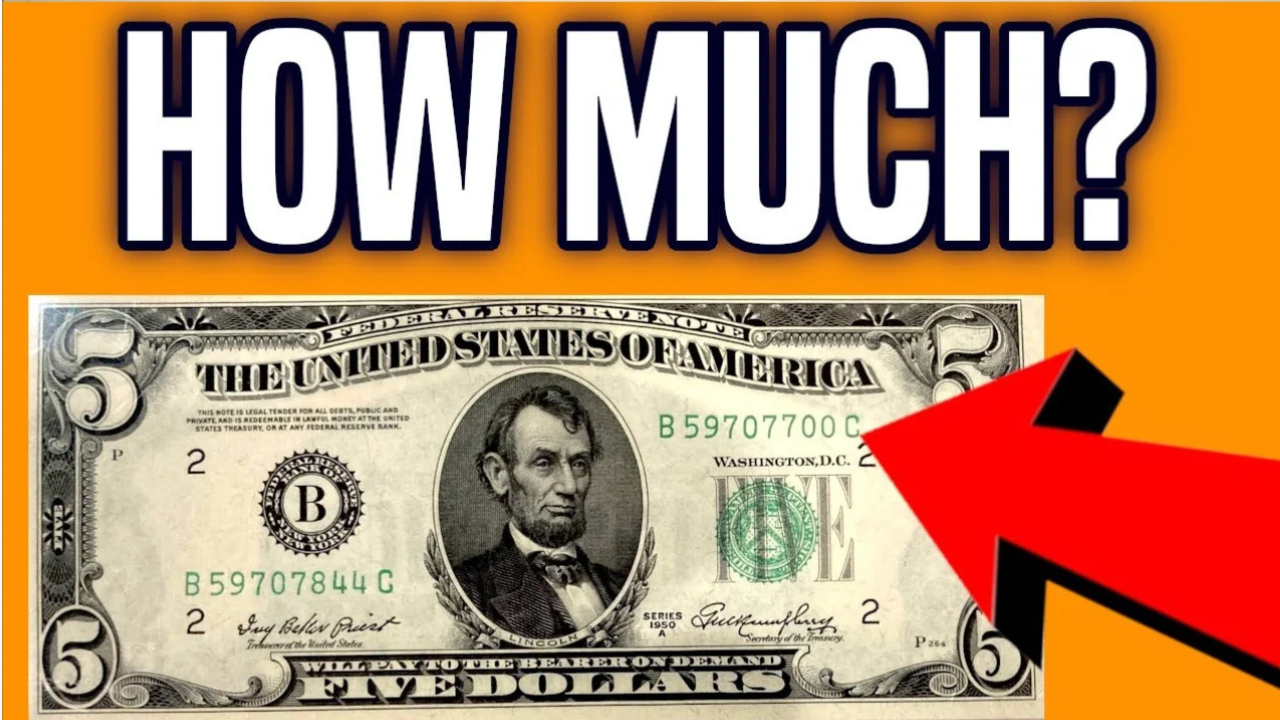
$5 Bill :If you’ve ever taken a close look at the cash in your wallet, you might be holding something far more valuable than its face value. One such intriguing currency note is the 1995 $5 bill with an inverted seal – a rare printing error that has captivated collectors and currency enthusiasts. What looks like an ordinary five-dollar bill could actually be worth hundreds or even thousands of dollars, if you know what to look for.
Let’s explore why this misprint is so special, how to identify it, and why collectors are willing to pay such a high price for this little piece of American history.
The Story Behind the 1995 Error on the $5 Note
In 1995, the Bureau of Engraving and Printing (BEP) printed millions of $5 notes featuring President Abraham Lincoln on the obverse. However, a rare mechanical error occurred during printing—resulting in the Treasury Seal or Federal Reserve Seal being printed upside down.
This type of error is called an “upside down seal” error. Such errors are rare because each note undergoes multiple levels of printing and quality checks. Only a few slip through the cracks, making them extremely popular among collectors and currency enthusiasts.
Why is the upside-down seal valuable?
Collectors love printing errors because they represent unique moments in American currency history. When an error is discovered, it usually attracts attention due to its rarity, and its market value rapidly increases due to demand.
- The 1995 $5 note with the upside-down seal is special because:
- These are extremely rare. Only a few notes made it out of the printing press before the error was discovered.
- It’s very visually striking. The inverted seal is immediately noticeable, making it a collector’s dream.
- It’s from a recent year. Unlike older currency, it’s still modern enough that it could theoretically still be found in circulation.
Depending on the condition, these notes have sold for anywhere from $500 to over $3,000, especially when verified by a professional grading service.
How to Identify the Upside-Down Seal on a 1995 $5 Bill
Finding one of these rare bills requires a sharp eye. Here’s what to look for:
-
Date and Series:
-
The front of the bill should read “Series 1995.”
-
Look for signatures from Treasurer Mary Ellen Withrow and Treasury Secretary Robert E. Rubin.
-
-
The Treasury Seal:
-
The seal is typically located to the right of Lincoln’s portrait, near the middle-right section of the bill.
-
In normal notes, the seal appears upright — the top of the seal should face the same direction as Lincoln’s head.
-
-
Error Detail:
-
On misprinted versions, the Treasury seal is printed upside down or at a noticeably tilted angle (some appear rotated up to 180 degrees).
-
If the seal looks inverted, off-center, or at an odd angle, you may have a rare error note.
-
-
Serial Numbers and Seal Alignment:
-
The serial numbers and the Federal Reserve seal (to the left of Lincoln) should be properly aligned.
-
If the seal error occurs but the serial numbers are correctly placed, that’s a sign of a genuine misprint — not tampering.
-
How to Determine Authenticity
If you think you’ve found a 1995 $5 bill with an inverted seal, don’t rush to sell it. First, verify its authenticity using one of these methods:
-
Compare it to a standard 1995 $5 bill.
The differences should be readily apparent.
2. Consult a professional currency grader.
Services like PMG (Paper Money Guaranty) or PCGS Currency can authenticate and grade your bill.
3. Avoid altering or cleaning the bill.
Any damage or alteration can significantly decrease its value. Keep it flat and in a protective sleeve.
4. Check for other errors.
Some rare bills also have ink smudges, double prints, or shifted seals, which can enhance their desirability.
Where to Sell or Appraise Your Bill
If your bill’s authenticity is confirmed, you can:
- List it on auction sites like eBay or Heritage Auctions.
- Consult a coin and currency dealer who specializes in misprints.
- Join collector forums to connect with potential buyers and experts.
Prices vary depending on condition, but if the error is obvious and verifiable, even low-circulation notes can fetch a good amount.
Final Thoughts
The next time you hold a $5 bill, take a close look at it. You might have a rare 1995 $5 bill with an inverted seal lying unnoticed in your wallet or change jar. For collectors, it’s more than just a printing error—it’s a tangible piece of history, a small mistake that has become a valuable treasure.
So before you spend that five-dollar bill, check the money in your pocket—it might be worth hundreds or even thousands of dollars.
Frequently Asked Questions (FAQs)
Q1: How much is a 1995 $5 bill with an upside-down seal worth?
Depending on its condition and demand, it can sell for $500 to $3,000 or more.
Q2: Is every 1995 $5 bill with a tilted seal valuable?
Only significant misalignments or full inversions are valuable. Slight misprints are usually worth little extra.
Q3: How can I confirm if my bill is genuine?
Use professional grading services like PMG or PCGS Currency to verify and appraise your bill.
Q4: Are newer bills with errors also valuable?
Yes. Modern printing errors can also be collectible if they’re rare and authenticated.
Q5: Can I spend the bill if it’s rare?
Technically yes, but it’s far more valuable to collectors than its $5 face value. It’s better to keep or sell it.